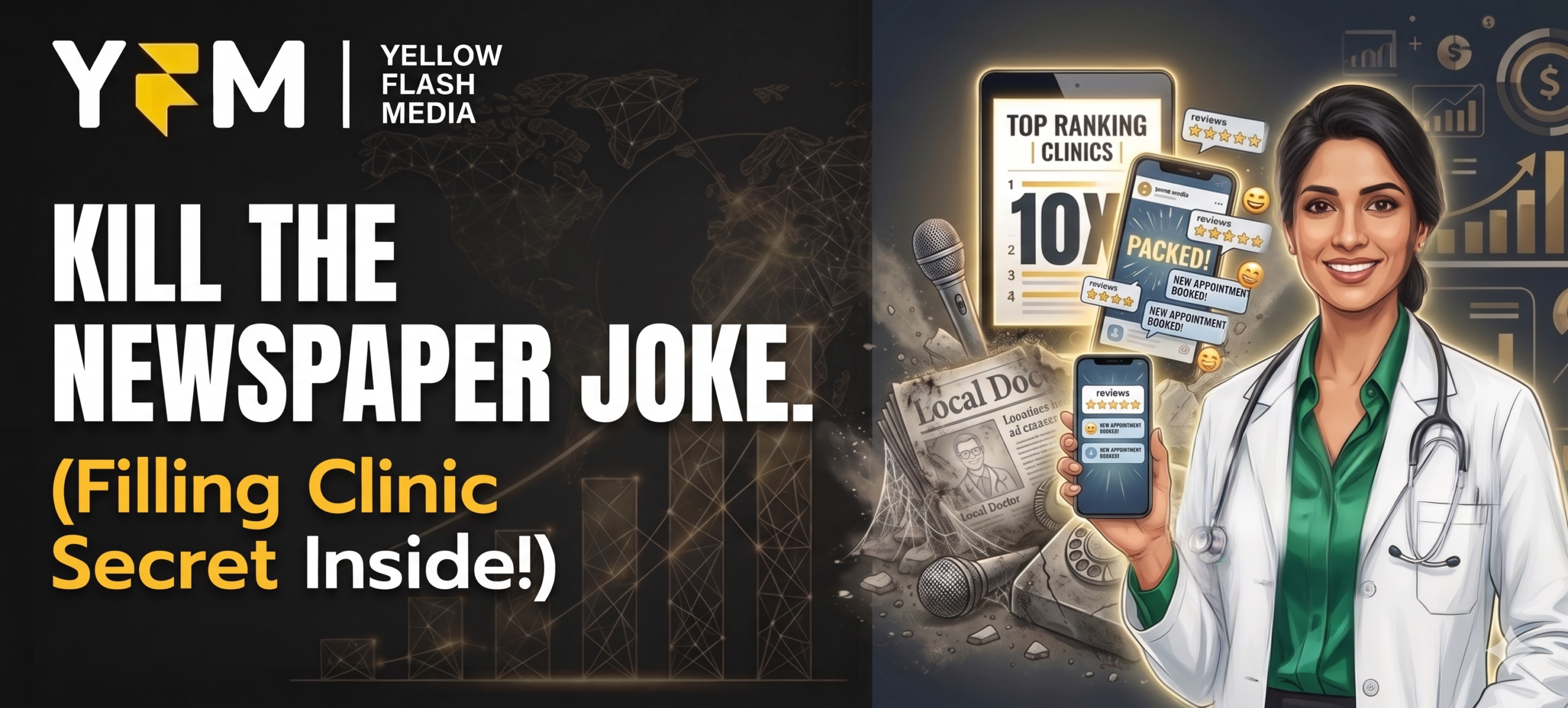
If you’re a doctor, clinic owner or a small business operating in healthcare, you’ve probably asked yourself: “Is it still worth investing in newspaper ads, local radio spots or door-to-door flyers for my clinic?” The short, bold answer: Probably not — at least not as your primary marketing strategy. In today’s digital-first world, the rules of patient acquisition and clinic growth have changed dramatically.
In this blog, we’ll explore why traditional marketing doesn’t work for clinics anymore, draw out clear examples, expose the pain points, and then show you how to shift into a modern approach that delivers results.
1. What’s changed?
Imagine this: A new clinic opens in your city and splashes out on billboards, local newspaper ads and a bulk-mailer campaign. Six months later—the phones have barely rung, walk-ins are minimal, and the receptionist’s follow-ups are slow. Meanwhile, your competitor launches a Google Ads campaign, posts patient-education videos on Instagram and appears at the top of “clinics near me” when someone searches on their phone—and gets inquiries.
What changed? Two big shifts:
- The behaviour of patients: More of them are online, searching, comparing, reading reviews, before they ever pick up a phone. For example, 65% of patients research providers online before contacting them. Amra and Elma LLC+2primecloudcare.com+2
- The tools marketers and clinics have: With digital channels, you can target, measure ROI, test creatives and optimise. With analogue traditional methods—you mostly can’t. For example, one study found traditional marketing accounted for 67% of the budget, but only 9.7% of new patients cited it as their reason for choosing a practice. PMC
So if you keep relying on print ads, posters and unspecific mass media, you’re targeting yesterday’s patient journey.
2. What is “traditional marketing” — for clinics?
Before digging deeper, let’s clarify what we mean by traditional marketing in the clinic/health-business context:
- Print-ads (newspapers, magazines)
- Billboards, banners, outdoor signage
- Flyers, pamphlets, direct-mail postcards
- Radio, local TV spots
- Yellow Pages, directory ads
- Sponsorships of local events without digital follow-up
These approaches were once valid, but for modern clinics they face major limitations.
3. Why traditional marketing is failing clinics now
Poor targeting & wasted budget
Traditional channels cast a wide net. For example, printing flyers and distributing them locally means many recipients may never be interested in your clinic’s specialty. In contrast, digital ads let you target by demographics, interests, location, even behaviours. One infographic comparing traditional vs digital marketing for clinics said:
Traditional: “Hard to track ROI”, “Not precise targeting”
Digital: “Laser-focused targeting”, “Real-time data & analytics”.
That means for clinics especially (where patients are specific: age, condition, location), the budget is being less efficiently spent.
Hard to measure effectiveness
With flyers or newspaper ads: how many readers saw it? How many of them made an appointment? Which message worked best? Most of this becomes guesswork. A report noted the major weakness of traditional clinic marketing was precisely this “lack of ability to track return on investment.” Health Works Collective
In healthcare business, every patient matters — wasted ad spend reduces margin.
Patient behaviour has moved online
Patients no longer open the Yellow Pages or respond to generic mailings in large numbers. Instead:
- 81% of patients research healthcare providers online before booking. primecloudcare.com
- 70% of healthcare consumers use digital channels to find health information. WifiTalents
Meaning: if your clinic isn’t visible or compelling online, you’re invisible to a large chunk of potential patients.
Traditional formats don’t support modern expectations
Today’s patients expect:
- Instant information (online booking, chat, reviews)
- Mobile-friendly experience (most searches are on mobile)
- Social proof (reviews, testimonials)
Traditional formats like print or billboards can’t deliver those dynamics. For example: mobile searches for healthcare services increased by 125% from 2019-23. ZipDo
Older audiences remain, but younger & middle-aged patients dominate
If your clinic serves a younger demographic (20-50) or specialises in elective/aesthetic treatments, then relying on older-media channels (print, radio) means missing your key audience. The advertising medium must match the audience habits.
4. Real-world scenario: clinic stuck in traditional trap
Dr Mehra runs a multi-specialty clinic in an urban suburb. His marketing budget is mostly allocated to local newspapers, billboards and clinic brochures. After 12 months his leads are flat. On the other hand, his competitor next door launched a blog + SEO strategy, posted patient-friendly content on social media, captured Google local listings and within 9 months saw a 35 % increase in new patient appointments.
Why did Mehra’s strategy lag?
- Newspaper readers had little urgency and click-to-book options.
- Billboards generated awareness but didn’t guide patients to take action.
- There was no tracking, so the team couldn’t measure which message worked or optimized.
- Online search queries like “best dermatologist near me” or “child cardiology clinic Bhopal” were not being captured.
In contrast, the competitor understood the new journey: search → review → website → appointment. The competitor invested in what we call: doctor digital marketing, online marketing for doctors, and doctor personal branding — instead of only traditional branding or passive media.
5. What clinic owners worry about (and objections)
Objection 1: “But print ads make us look local-trusted, and older patients do still read newspapers.”
→ True. Traditional media can still play a role: for purely local targeting, or among an older population. However, the question is how much of your budget and what the measurable outcome is. Many clinics treat it as their main strategy when it should only be one piece of a broader mix.
Objection 2: “Digital marketing is too technical / too expensive for my clinic.”
→ It can seem intimidating initially. But the cost-per-lead in digital channels can be much lower (and is measurable). As one study found: content marketing in healthcare generated 3x more leads than traditional methods. ZipDo+1
Also, partnering with a specialised agency (for example a digital marketing agency for doctors) helps simplify the process.
Objection 3: “Our brand already has a good local reputation — do we need search optimization or social media?”
→ Yes — because reputation alone isn’t enough if potential patients can’t find you when they search, or find a competitor first. 78 % of patients say online reviews influence their choice of a healthcare provider. ZipDo+1
So online visibility + trust are now essential.
6. The modern alternative: how to move forward
If you accept that traditional marketing alone won’t cut it anymore, here’s how to build a more effective strategy (with keywords you’re likely looking for: digital marketing for doctors, branding for doctors, physician branding and marketing).
Build a strong digital footprint
- Optimise your website: mobile-friendly, fast loading, clearly describes your services, has online booking options.
- Local SEO: make sure your clinic appears for “clinic near me”, “doctor in {city}”, “specialty + city”. For a small clinic this is crucial.
- Reviews & reputation: Encourage satisfied patients to leave reviews; monitor what’s said; respond to feedback.
Use content & storytelling for trust-building
Patients are looking for information, not just ads. Create blog posts, videos or FAQs that answer real questions like: “How to choose a paediatric cardiologist?”, “What parents should know before child surgery?”, “Signs you need a spine specialist.”
This is where doctor personal branding also comes in — by sharing your story, your expertise, you build authority and patient trust.
Leverage targeted advertising
Use Google Ads, Facebook/Instagram ads (if relevant) aimed at people within your city or region who are searching for services you offer. Since digital allows you to measure ROI, you can stop wasting budget on channels that don’t perform.
Data tracking & optimisation
Set up tools so you can see: number of leads, cost-per-lead, conversion rate (lead to appointment), which channel is working best. With traditional methods you couldn’t do this easily; now, you can pivot and invest in what works.
Blend traditional wisely
Traditional marketing isn’t dead — it just can’t be the only or main pillar. For example:
- Use local flyers for older demographic or community outreach, but include a QR-code to your website or Google listing.
- Use local radio to raise awareness of a “free health check” event, and track signup via landing page.
This way, you still have presence but tie it to digital tracking.
7. Why your clinic needs a specialist approach (and how we help)
As the founder of Yellow Flash Media, a marketing agency for doctors, I’ve seen clinics allocate budgets in traditional channels thinking “that’s what every business does”. But clinics are not retail stores — the decision process (for patients) involves research, trust, online presence before they walk in.
Here are two quick case-studies:
- One clinic switched from local newspaper ads into a combined SEO-social-content strategy and saw “new patient appointments” grow **by 35 % in nine months”.
- Another specialising in aesthetic procedures found that online video content attracted higher-value patients than generic print ads.
Your clinic deserves a tailored strategy: online marketing for doctors, doctor digital marketing and physician branding and marketing are the keywords you should keep in your mind.
8. Summary: key take-aways
- Traditional marketing is less effective for clinics today because patient behaviour, competition and technology have shifted.
- Print, local radio, flyers can still play a role — but they’re no longer sufficient as the main strategy.
- Digital channels offer better targeting, measurement, scalability and trust-building for healthcare providers.
- Your ideal marketing strategy will blend online visibility (SEO, social, content), targeted ads, reputation management, and selective offline support.
- If you’re a clinic owner or doctor, moving away from a “spray-and-pray” traditional mindset to a more data-driven, patient-journey-centred approach will differentiate you in a crowded market.
✨
If you’re ready to stop guessing and start growing — let’s transform your clinic’s marketing. Book a free strategy call with Yellow Flash Media today and discover how to attract more patients, boost your reputation, and build your personal brand as a doctor. 👉 Click here to book your call.
You don’t have to fight the marketing battle alone — let’s make your clinic visible, trusted, and visited.